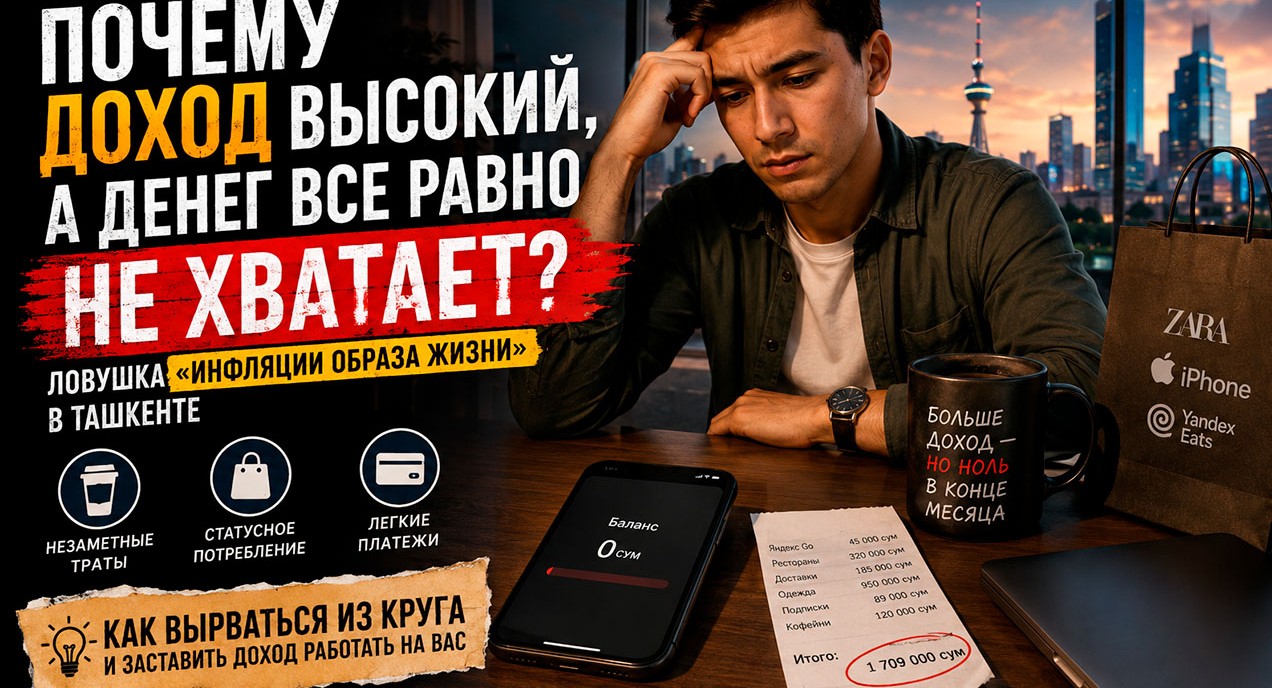
A familiar situation: you started earning significantly more—got a promotion, switched to contracts with foreign clients, or scaled your project. It seems financial problems are now a thing of the past. But after a couple of months, you're surprised to discover that your Humo or Uzcard balance is again approaching zero by month's end, while major goals (buying your own apartment in a new building, launching a startup, or building investment capital) remain just plans.
In financial psychology, this phenomenon is called lifestyle inflation. It's a trap that often catches above-average earners. Let's understand why this happens and how to make growing income work for you, not fleeting whims.
4 Main Reasons Why Money 'Melts' at High Income
1. Growth of Invisible Daily Expenses
When income rises, our 'wants' instantly become 'basic needs'. You stop checking lunch prices, increasingly order Yandex Go Comfort+ instead of regular taxis, and buy morning coffee exclusively at trendy cafes on Taras Shevchenko Street. Each expense seems small, but together they create a huge hole in your monthly budget.
2. The 'Digital Money' Illusion and Easy Transfers
Integration of payment systems (Click, Payme, Uzum Bank) made spending incredibly easy. Paying for endless food deliveries via Yandex Eats or Uzum tezkor, impulse purchases on Uzum Market, and quick P2P transfers create the feeling you're not overpaying anywhere. In reality, lack of physical cash contact lowers the psychological barrier to spending.
3. Status Consumption and Social Pressure
Tashkent is a city where social status still carries enormous weight. When income rises, your environment or inner critic starts whispering: 'Time to upgrade your car (switch from Gentra to Tracker or Malibu)', 'You need the latest iPhone', 'Wear only branded clothes'. People spend not because they need it, but to match a certain success marker.
4. Lack of 'Pay Yourself First' Rule
When money increases, a dangerous sense of financial immortality emerges. It feels like this will last forever, so building an emergency fund or investing seems premature. Eventually, all free money goes to current consumption.
How to Break This Cycle: Step-by-Step Plan
To turn growing income into real capital, you need to regain control of your financial habits.
Step 1: Conduct a Digital Audit for 2 Months (Analysis)
No need to write every sum in a notebook. Open your bank apps and export spending history. Group expenses by category: 'Taxi', 'Cafes and Restaurants', 'Subscriptions and Deliveries'. The monthly figure will definitely open your eyes.
Step 2: Automate Savings (Implement the Rule)
The main budget secret: set aside money on income day, not at month's end from leftovers. Configure automatic transfer of 15–20% from any income to a non-withdrawable som deposit with high interest (currently around 20–22% annually). Keep this money out of your daily wallet.
Step 3: Implement the '48-Hour Rule' for Major Purchases (Combat Impulse Spending)
Found a new gadget, expensive watch, or branded item at the mall? Don't buy immediately. Take a 48-hour pause. If after two days the desire remains strong and won't hurt your financial goals—purchase it. In 70% of cases, emotions fade within this period, and you realize you don't need it.
Step 4: Redefine 'Status' (Mental Shift)
True financial status today isn't a loan for an expensive car or the latest smartphone. It's your net capital size, a diversified stock portfolio on RFB 'Tashkent', income-generating real estate, and confidence you can live comfortably for years without working.
Key Takeaway
A wealthy person isn't someone who earns a lot and spends it all, flaunting luxury. A wealthy person is someone who maintains and increases the significant gap between income and expenses.