Uzbekistan's financial landscape in 2026 looks incredibly dynamic. The period when the only understandable way to preserve savings was to buy cash dollars under the mattress or open a classic deposit officially belongs to the past. The national currency is strong, financial technologies are developed, and the choice of instruments for a private investor has become wider than ever.
The main trump card of the current moment, which financial consultants never tire of mentioning, is absolute tax freedom (0% rate) for individuals on income from bank deposits, bond coupons and stock dividends. All accrued profit goes directly to your pocket.
But where exactly should you direct your free soms in 2026 to get the maximum result and avoid bankruptcy? We compare three main instruments — deposits, bonds and stocks — and figure out what smart investors choose.
1. Som deposits: Rock-solid comfort for conservatives
Bank deposits remain the most popular and psychologically understandable instrument in the republic. In 2026, digital and traditional commercial banks (Anorbank, TBC, AVO, Agrobank and others) offer very impressive rates on som online deposits — from 18% to 23% per annum.
Pros: Maximum simplicity. You open a deposit in a mobile app in two seconds, know your return exactly, and are protected by the state. The Deposit Guarantee Fund ensures 100% safety of amounts up to 200 million soms in one bank.
Cons: Deposits don't protect against lower rates in the future. Most profitable deposits are opened for 3 months to 1–1.5 years. If rates in the economy drop within a year, you won't be able to reopen a deposit at the same 22%. Plus, with early withdrawal, you almost always lose all accumulated interest.
2. Bonds: Strategic fixation of high returns
Bonds on the Tashkent Republican Stock Exchange in 2026 are experiencing a real boom among those who've outgrown regular deposits.
Government bonds offer maximum-level reliability with yields around 18–20% per annum, comparable to bank deposits, but without the state guarantee limit.
Corporate bonds from local banks, leasing companies and industrial enterprises allow you to earn much more — coupon rates reach 24–27% per annum in soms.
Pros: Bonds allow you to "lock in" high yields for a long time — 2 to 5 years. Whatever happens on the market, you'll steadily receive your 25% per annum. Another hidden advantage is liquidity. If you urgently need money, you can sell bonds on the exchange any working day and fully preserve earned interest for each day of ownership (thanks to accrued coupon income).
Cons: You need to open a brokerage account and pay a small transaction commission (averaging 0.5–1%). When buying corporate bonds, you must independently assess company reliability to avoid default risk.
3. Stocks: High risk and potential for multiple growth
Investments in equity instruments (stocks) — is the choice of those willing to tolerate temporary price fluctuations for potentially unlimited profit. Uzbekistan's market is actively privatizing, major players are going public, and the launch of the National Investment Fund (UzNIF, ticker UZNF) opened the door to passive collective investing.
Pros: You earn twice — on company value growth and regular dividends (which from banking and telecom sector leaders can be quite generous). Stocks are the only instrument capable of outpacing real inflation in the long term during a period of rapid developing economy growth.
Cons: There are no guarantees. Stock prices on the Tashkent Stock Exchange can rise 50% in a year or fall 20% due to poor quarterly reports or general market sentiment. The instrument is definitely unsuitable for storing emergency funds.
Comparative analysis of instruments in 2026
| Comparison criteria | Som online deposits | Bonds (Gov and Corp) | Stocks of local companies |
|---|---|---|---|
| Expected return | 18–23% per annum (fixed) | 18–27% per annum (fixed) | Unlimited (growth + dividends) |
| Investment period | Short (up to 1–1.5 years) | Medium and long (1–5 years) | Long-term (from 3–5 years) |
| Interest preservation on early exit | No (lost completely) | Yes (preserved for each day) | Depends on current market price |
| Capital protection | High (state fund up to 200 mln soms) | From absolute (gov) to moderate | Market risks, no protection |
| Tax rate (2026) | 0% | 0% | 0% |
What to choose: step-by-step budget allocation strategy
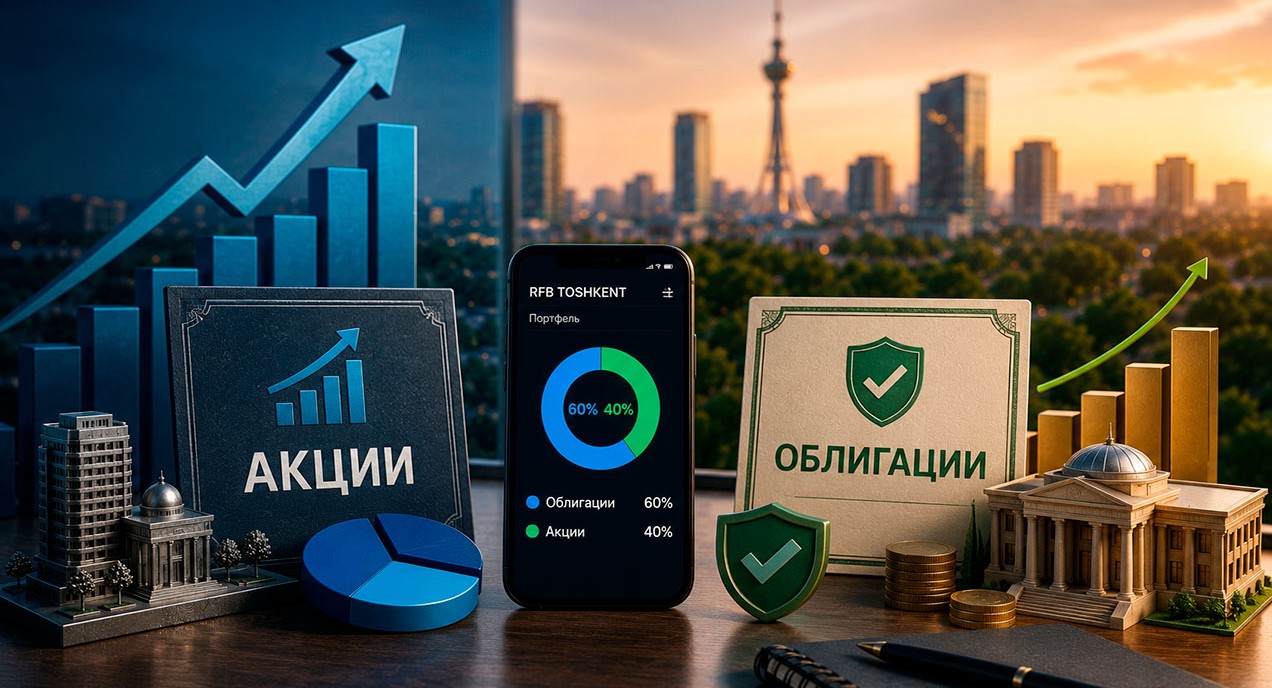
In 2026, the stupidest decision would be to put all savings in a single safe. Smart investors combine these instruments based on priorities.
Step 1: Build a safety cushion with deposits
Direct an amount equal to your 3–6 monthly expenses to a flexible som online deposit at 20–22% with partial withdrawal options. This is your untouchable reserve for emergencies, protected by the state.
Step 2: Lock in passive income through bonds
Money you definitely won't need in the next 2–3 years should be transferred to a brokerage account. Buy reliable corporate or government bonds to guarantee payments at 24–27% per annum and protect capital from potential future rate decreases.
Step 3: Allocate a share for long-term growth in stocks
Direct the remaining 10–15% of your investment budget to equity instruments. Buy stocks of key profitable enterprises or diversified shares of UzNIF fund. Forget about this money for 5 years — let compound interest and the country's economic growth do their work.
Main conclusion
Main conclusion: In 2026, there is no perfect single instrument. Deposits provide immediate liquidity, bonds — long-term stable above-market returns, and stocks — a chance for capital appreciation. Manage your money through a diversified portfolio, maximize Uzbekistan's tax-free benefits, and regularly reinvest earned income.